Posts

Thanksgiving Traditions
Image
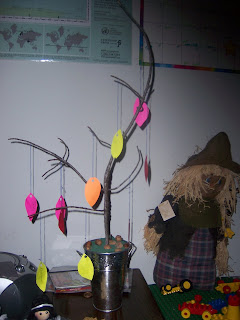
Froggy just turned two and this is our first Thanksgiving in our own house. My in-laws joined us for the holiday. That being the case traditions have been a tremendous focus of my thoughts and conversations for the past week. I need to meld two families worth of very contraditory traditions as well as try to create some special traditions for my daughter. In my family, most of the traditions revolve around food and it is the woman's job (for good or bad) to make that food. I love our family traditions but I don't want my daughter to feel bound to the kitchen as the only way to special memories. But Thanksgiving and many other holidays are not the same without the traditional foods. And I love to make those traditional foods and teach my daughter to make those traditional foods. But while teaching her to cook, I try desperately to teach her that I cook because I love to cook not because it is a woman's job to cook. As well, it is important to me that every holiday ha...

Phonics vs Whole Language

As an educator and a compulsive planner, I started investigating reading-readiness programs while Froggy was still a tadpole. There was no doubt in my mind that we were going to use a phonics program. The only question was which one. I looked at many many different programs over months and months before picking one, all before she turned one. Since it was clearly not needed for a long time, it got shelved and forgotten. Meanwhile as suggested, we purchased and played with letter puzzles and magnetic letters and an amazing toy, Fridge Phonics , which quickly became a favorite. So time passed and Froggy turned 2. She knows her letters and the sound they make. She suddenly and unexpectedly (to me at least) starts filling in the words when I am slow completing a page in the book we are reading. So periodically, with some larger print books, I start pointing at the words as I read and deliberately pausing for her to "read" certain words. She desperately wants to read and j...

Carnival of Homeschooling

The Carnival of Homeschooling I am Thankful edition is now up at Nerd Family . It is a nice preamble to the upcoming holiday. I enjoyed all the different things we are thankful for.

Learning Styles

I got an uncomfortable yet educational lesson in Learning Styles today. When I was a classroom teacher, I tried to follow the prevailing wisdom of providing the students with several different types of assignments during each class period so that no single activity took more than about 10-15 minutes. I was horrible at it. Yet the students seemed to enjoy those classes more. So I kept trying. I would always come out of those days feeling horribly horribly frazzled. I thought it was because I was not sufficiently organized. Today, as a student, I experienced the other side of the coin. In my class this evening, the professor moved from activity to activity switching between lecture, small group discussion, whole group discussion, and individual work. By the end of class, I felt raw. I cringed every time he started to introduce a new activity. The material is easy and fascinating for me. But the short time between transitions grated my nerves creating an unpleasant learning envi...

Nutrition - toddler

Many parents (I hope) know that good nutrition is important to babies. But frequently when our children become toddlers, something gets lost. A recent study showed that 2% of children under 2 eat French fries daily and 24% eat hotdogs daily (Fox, Pac, Devaney, & Jankowski, 2004). As well, most preschoolers consume soft drinks regularly. I find those results shocking. Birth to 2yrs is the time of maximum brain growth. We are supposedly a culture that prides itself on intelligence and fast paced thinking but we are crippling our children’s ability to get there. Multiple studies have shown that children who receive the right nutrition from birth to 7 scored higher in quantitative thought and expression, reading, and vocabulary 10 years later (Pollit & Gorman,1994; Pollit, Watkins & Husaini 1997) . Our society is crippling itself with poor nutrition. We have programs to help the nutrition of our school-aged children, as lame as it is. We have programs ...

Children's Questions

I love books that help me answer the questions my toddler asks. She asks questions that my scientist mind wants to answer with richness and depth. And I will someday. But I know these answers are not age-appropriate and she won't understand them. So I hunt out fun books that help me explain in honest yet simplistic terms to her the answers she wants. Our latest discovery is When the Wind Stops to explain why it gets dark at night. It is a bit complicated for her sense of space but I think with repeated readings, the ideas will sink in.

Lets get moving

Learning starts early, earlier than most people credit. It starts with brain development. Since sensory input and moter development in the brain are heavily linked, the entire field is called Sensory-motor development. Unbeknowst to most people, a critical component of this system is the vestibular system of the inner ear. It controls movement and balance. It also influences the other sensory systems. Most of the development and building of this system occurs from birth to 2yrs. New research among scientist show that a lack of stimulation to this system can lead to dozens of learning problems. Early motor stimulation can help provide better attention, listening skills, reading scores and writing skills. So how do we provide stimulation? Through movement. Even simple movement such as rocking. Recent studies show that most children do not receive enough stimulation. Babies are now spending so much time in their carseats (even when not in the car) that they are not getting the...

Multile Intelleginces and Learning Styles

In class today, we discussed Multiple Intelligences and Learning Styles. According to the Multiple Intelligence indicator in So Each May Learn, I am a well rounded person who excels in both interpersonal and intrapersonal intelligences. This comes as no surprise since I have always been described as a people person and I am very comfortable with myself and others. Silver describes Multiple Intelligences as the what of learning and the learning styles as the how of learning. If I am following what this is saying is multiple intelligences indicates the way our brain works like a more detailed IQ while learning styles indicates study techniques and how to process material. Using that description, I can see where knowing the learning styles of your students and helping them understand their learning styles is important. According to text, I am a sensing-feeling learner. This makes perfect sense especially when compared with the MI results. I wonder if such a correlation exists fo...

Today's Lesson - Mi She Berach

This morning during breakfast, we learned that my husband's sister, who is already on super high level chemo, found another lump. Not good news. Froggy was sitting in my lap when I got news and felt my concern. So I took the opportunity to teach Froggy a new prayer - Mi She Berach. She knows her daily prayers - Motzi for meals and Shema at bedtime. I explained to her that Aunt L has a big booboo too big to kiss and make better so we need to ask G-d to help her feel better. And the way we ask G-d for things is through prayer and there is a special prayer called Mi She Berach that we use when we want G-d to help someone feel better. Then we prayed and sang the Debbie Friedman song. Later while swinging at the park, she asked to say MiSheBerach again so "G-d make Auntie L feel better".

Making Learning Meaningful

Using the learning is what makes it stick for me. I need to see it in action. It needs to be relevant to my life and real. I am teaching my daughter. The lessons I learn teaching her are some of the most powerful lessons. Lessons I learn by way of personal problems stick more quickly than lessons learned from a teacher or from others. If I need to learn something to be able to do what I want to do then the learning will stick. For example - I learned to properly build a fire on a camping trip when my partner forced the issue. I had previously coasted through trainings, through demos, and teaching girls with basic skills and shadowy knowledge. Out in the field I would let me program aides build the fire because they were "faster". On this trip there was no one else willing to do it. It was me or freeze. I am now competent if not fast.

My Research Question

In my class we are preparing to do an action research study which means investigate in depth on aspect of our teaching. My research question is roughly what is the most effective method to help a non-reader "break the code" to become a fluent reader. Is one phonics system better than another? There is one system that does not teach letter names but instead has 40 "symbols" which are letters or letter combinations which supposedly represent the 40 different phonemes of the English language. Is this method better than other phonics system? Where can I find some research to guide me? All I seem to be able to find is by the author or proponent of the system and thus biased. A second part to question is when you are teaching phonics how can you tell if you are properly pronoucing the different phonemes or help a student who does not seem to be hearing the difference between two similar phonemes?

Assumptions and Beliefs

According to Lynn Fendler, a major criticism of reflection is "the degree to which [it] serves to reinforce existing beliefs rather than challenge assumptions." One way to avoid this is to make a list of the assumptions and beliefs prior to reflecting so that they are front and center. Here are some of my assumptions and beliefs I believe that all children are born with a desire to learn. I believe that most children lose this desire to learn through poor or regimented instruction Children learn what they live Learning must be active The mind can only learn if the body is cared for. Potential is a product of belief

Reflective teaching

In class, they keep drilling on how important it is to try to see the experience through the eyes of your student. For me this is easy. I can always tell where my teaching hit home and where it missed by what my daughter says back to me. It may take several days but it all comes out eventually. Sometimes it shows very clearly the topics we need to revisit while others it gives proof to the lesson learned. Our big miss of late "Mommy has booboo in big girl panties"

Babble

Most people feel that a little one's babbling is meaningless. It is not. It is their way of processing a new and interesting world. If one takes the time to listen to a child's solitary babble without commenting or interferring, one can learn much about how the child views the world, what importance he places on the events in his life, his hopes and expectations. None of this is to say that one should not talk to and with children but also give them time to themselves and listen quietly from the outside.

Moods and learning.

" How much people can learn at any given moment depends on how they feel at that moment about the task and their ability to do the task. When we feel powerful and competent, we leap at difficult task. The difficulty does not discourage us; we think 'Sooner or later I am going to get this' At other times we only think,"I will never get this, its too hard for me, I was never any good at this kind of thing, why do I have to do it," etc. Part of the art of teaching is being able to sense which of these moods the learners are in." [emphasis added] Holt,50 A public school teacher may be able to sense the mood of her learners but ehr ability to react to that is fairly limited and more limited is her ability to react when there are several different moods. Homeschooling makes this easy. As a parent, we are more aware and attentive to our children's every mood. As well we are more in touch with what is likely to affect that mood. Lastly we are not under ...

Works For Me Wednesday - The Learning Tower

We don't normally buy big expensive toys for Froggy and I justify this by considering it a piece of furniture. My passion is cooking and since Froggy was born I have been waiting to be able to share it with her. Now we can. She can reach the counter, see in to the bowl, stir with me and even help me crack eggs. Technically it is an early birthday present for her but we could not wait to start using. She is not even 2 yet and we really cook together on an almost daily basis. We purchased the additional play components for it and maybe one day we will take them out of the box but for now we are having too much fun being eye to eye For more Works for Me Wednesday ideas visit Rocks in my Dryer.

Critical Reflection

In his book Becoming a Critical Reflective Teacher Stephen Brookfield disc usses what it means to be critically reflective as a teacher. He defines reflection as hunting down and examining the assumptions we have. This is a definition that makes sense and provides a concrete model to follow. His examples though seem extreme and unrealistic. He sets up a serious of "common sense" examples that he then disproves. For instance, "It's common sense that teaching is essentially mysterious, so if we try to dissect it or understand its essence, we will kill it." Does anyone really believe that let alone think it is "common sense"? Obviously not all reflection is critical, so what makes reflection critical? According to Brookfield , two things. First is to "understand how consideration of power undergrid , frame and distort" the processes and interactions. The second component is to "question assumption and practices that seem to make ...

Assimilation and Accomodation

Why does a toddler call all four legged animals dogs? Assimilation. Understanding the process of assimilation and accommodation as described by Piaget was like a light bulb going off for me. Suddenly I understood what was happening in the Froggy's head. As an educator, we are repeatedly told that we need to "link to prior knowledge" so that whatever we are teaching makes sense to the student. Why is that important? Accommodation. Back to our example of the toddler just learning the world. Toddler repeated comes in contact with furry four legged beast which is given the label "Dog" Through the part of language development / learning designated assimilation, the toddler is able to make the a connection between the label and the item presented. The toddler then uses that label for anything else that meets that general description. It takes accommodation to allow the child to see that a cat is different than a dog or a horse is different than a cow or tha...

Guided Reflection Protocol

What implications does the GRP have for your practice and your continuing development as reflective educators? A step by step protocol for reflection is extremely helpful. A concrete guideline is useful for linear thinkers. The group dynamic makes the process tricky for me. Many of the problems I encounter and reflective moments are not times I am looking for external analysis. For those times when one wants or needs external analysis, the protocol is an effective method of ensuring that an action plan is created and that the reflection leads somewhere rather than being an opportunity to vent. It is not clear how the step 4 of Part One (What are the implications for my practice) is supposed to differ from Part Two (Possible Future Action). Although the protocol is designed to be used in a group setting, it is possible to use it as a solitary individual and accomplish the same objective. It offers a framework and a guideline which can be useful. Instead of getting lost in the problem an...

Reflection

This will be the new home for a journal I am required to keep for the class I am taking. I chose to place it here because I feel it melds nicely with the original purpose of the journal which is our journey in homeschooling and the class journal is a reflection on teaching styles and methods and what learning about those. All the new journal entries will have the tag of journal.